.svg)
Practical Applications to Our Farm From Extreme Ownership
We worked through these principles as a team. Here's what they look like on the farm.
Last year, we went through an Extreme Ownership training session with our entire farm team.
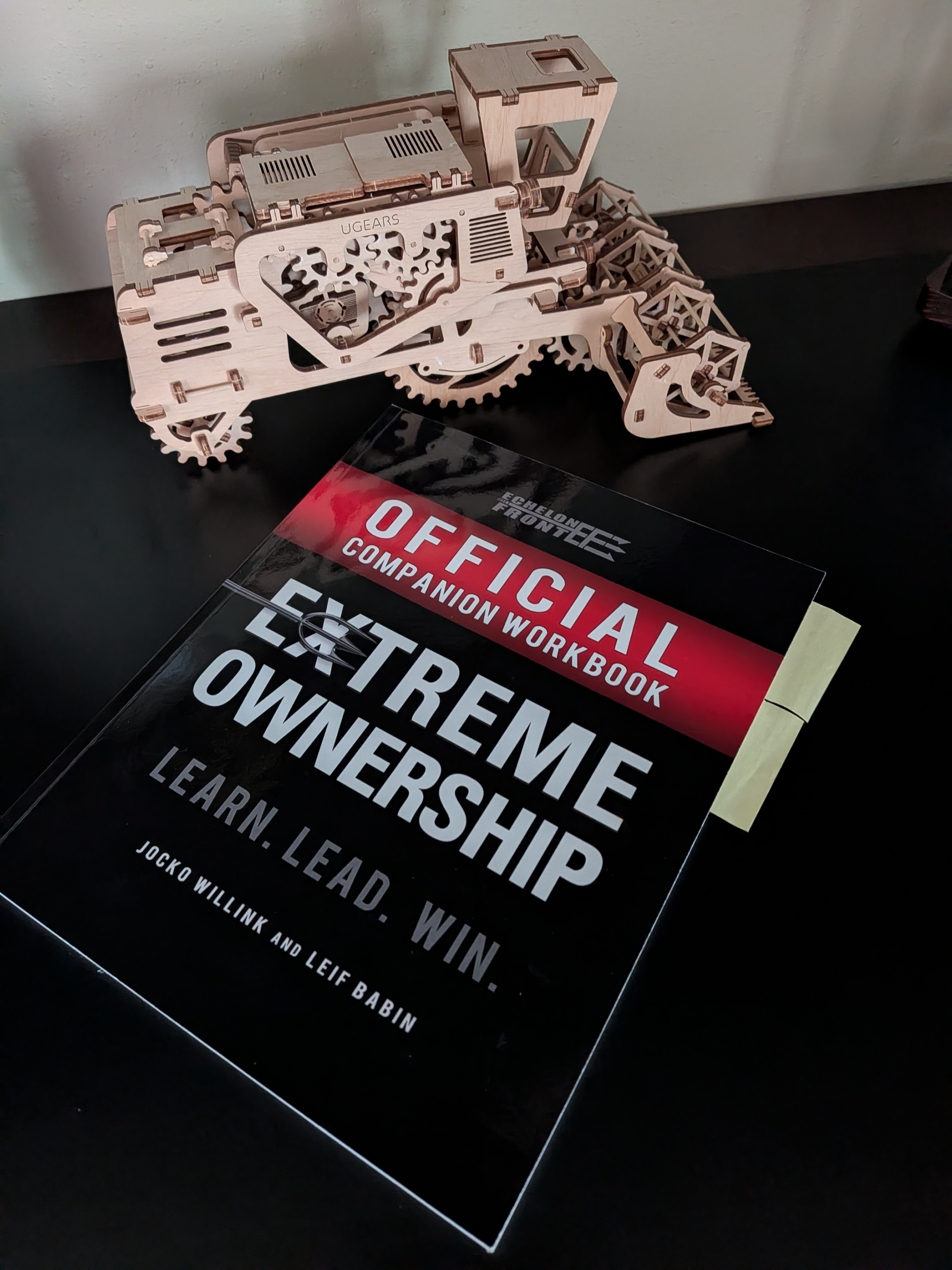
For those who aren’t aware, “Extreme Ownership” is a set of team principles created by Jocko Willink and Leif Babin, former Navy SEALs.
We find learning from the Navy SEAL organization valuable because, frankly, their main business is teamwork.
Plus, they’re cool.
Here are the Extreme Ownership principles and our aspirational applications for what they look like on the farm.
Principle 1: Extreme Ownership (The Foundation)
“Every outcome, positive or negative, is my responsibility, regardless of my position on the team. No blaming — I am responsible.”
Application:
Our work environment on the farm is dynamic, and the required skills and knowledge are diverse. A team that’s going to succeed here takes ownership.
Here’s an example:
“He stood there for 20 minutes watching the other person wash,” one team member complained about a newer team member.
Extreme Ownership says, “If a team member is underperforming, that’s my responsibility. How can I help course-correct this?”
That’s followed by coaching and candid conversations, like: “Do you know how you can be helpful here?” Or, “Hey, we don’t watch others work on this farm.”
Principle 2: Subordinate Your Ego
Humility is crucial for self-assessment, learning and collaboration. Ego hinders growth and decision-making.
Application:
On our farm, this sounds like:
- “I don't know.”
- “I forgot how we do this … (since it's been three years since this situation has manifested).”
- “Can this process be improved?”
- “Would you help me with this?”
These situations all benefit from team members' ability to check their ego. That keeps us open to learning and leads to better decisions.
Principle 3: Decentralized Command
Empowering team members — those closest to the work — with the authority to make decisions within the “commander’s intent” (the “why” that drives the decision) allows for faster, more agile execution.
Application:
We talk quite a bit about this one.
Because we're sending, for example, a planter operator 30 miles away. He needs to know if field conditions are acceptable or not.
The farm doesn't have the resources or time to dispatch someone else to make a decision. So he needs the judgment and authority to make that call.
This isn’t just something we practice in theory.
Midway through last year’s harvest, we stopped the entire harvest process to bring in field experts for a crop talk with our Tier 1 operators (the most experienced) so we could better react and adjust to specific in-season scenarios.
Principle 4: Cover and Move
Teamwork is paramount. Elements must support each other. If one unit fails, the others must cover and help them succeed.
Application:
We are rugged individualists here in the Midwest. How do we adopt a posture that supports teamwork?
On our farm, “cover and move” looks like jumping in without being asked. Sometimes, that can be as simple as: “If your job is done and someone else’s isn’t, go help.”
For example, a team member gets a call:
“You up for a road trip? When you get back to the farm (with your load of soybeans), hop in the pickup and drive 3.5 hours one way to pick up the combine part required to fix the breakdown that occurred 45 minutes ago. You probably won’t get back until after midnight, so don't come in until 9 a.m. tomorrow. The part will be sitting out in front of the store.”
That’s “cover and move.”
Principle 5: Prioritize and Execute
Focus on the most critical tasks first to avoid getting overwhelmed. Then act decisively.
Application:
Sometimes we get caught up in a “crisis.” For example, in the live battle-fire of harvest, a gate stays open, and suddenly there’s a pile of corn on the ground larger than two pickups.
Moments like these are often remote, so the person on site has to make a call.
So, using the example above, the decision wouldn’t just be: “Where’s the shovel?” (Because that will take two hours if I do it alone.)
The thought process to prioritize and get to the decision might look like: “What’s the priority to complete a successful mission? Do I stop what I’m doing to clean this up? How does that impact, for example, the harvest operation? Do I call in help? How does that affect other ancillary operations? Do I leave it for another group to tackle later in the day?”
Then we execute.
Principle 6: Keep it Simple
Plans and orders must be clear and concise to prevent confusion. This is what enables rapid adaptation.
Application:
Growing a crop can be extremely dynamic. You can't just choose to control weed pressure by the calendar.
You need to stage a crop, stage the pressure, understand the weed control operations previous to and after the current task, have the correct quantity of product, a ready and able machine (and operator), know the primary and secondary targets, the field conditions, current weather and forecasted weather ( ... catching my breath).
That’s why simplicity matters. Simple directives, processes and good infrastructure (think tools) are essential.
Principle 7: Lead Up and Down the Chain
Communicate clearly with superiors and subordinates, manage expectations and provide the necessary information.
Application:
Clarity is kindness. And candid conversations go both ways.
That’s why we encourage our people to raise questions early (and often) when priorities aren’t clear.
This can be as simple as: “If you don't know if the mower blades need to be sharpened, ask.”
Or applied in more complex scenarios:
“I’m not sure what to do here,” says an operator at the edge of the field. “I understand we're supposed to efficiently cover acres because the rain is coming tonight, but at the expense of quality? I need to call my supervisor and get a better understanding of the overarching goal (the commander’s intent) so we can make the right decision and execute.”
Principle 8: Default to Aggressive
Be proactive, seize initiative and attack problems rather than waiting for them to dictate action.
Application:
In farming, there are a myriad of uncertainties. Many of the questions we ask ourselves are unknowable. We believe the correct response to default to aggressive: make a decision and move on.
That doesn’t mean being reckless. It means that we don’t freeze.
The Extreme Ownership framework isn’t an end-all way to run a team — or even unique.
But it’s been useful for us.
It’s helped us look internally, identify common challenges and build a shared culture that helps us collaboratively rise above the noise and succeed as one team.
Reid Weiland is the managing partner of Weiland Farms. He oversees the farm’s day-to-day operations and leads all land management and farmland acquisition efforts.